Material names alone do not tell you whether an office chair will stay comfortable, stable, and serviceable through years of daily use. By comparing construction, adjustment systems, test evidence, fit, and maintenance requirements, you can turn a manufacturer’s feature list into a practical buying specification.
Key takeaways
- Compare mesh, fabric, leather, and plastic by heat, cleaning, wear, and repair.
- Request load ratings, test reports, warranty terms, and replacement-part details.
- Test seat depth, lumbar support, armrests, recline, and height before ordering.
- Match chair configuration to desk height, room layout, users, and daily work duration.
What Each Office Chair Material Changes in Daily Use
Seat comfort does not follow cushion thickness. A plywood seat pan gives a firm foundation, while pan shape, waterfall front, foam construction, upholstery tension, and your posture decide whether pressure builds under your thighs. A thick cushion can still feel hard at the edge.
| Material | Daily-use effect | What to check |
|---|---|---|
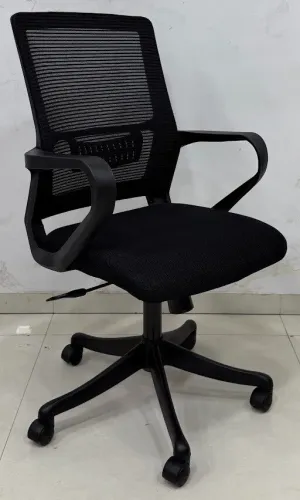
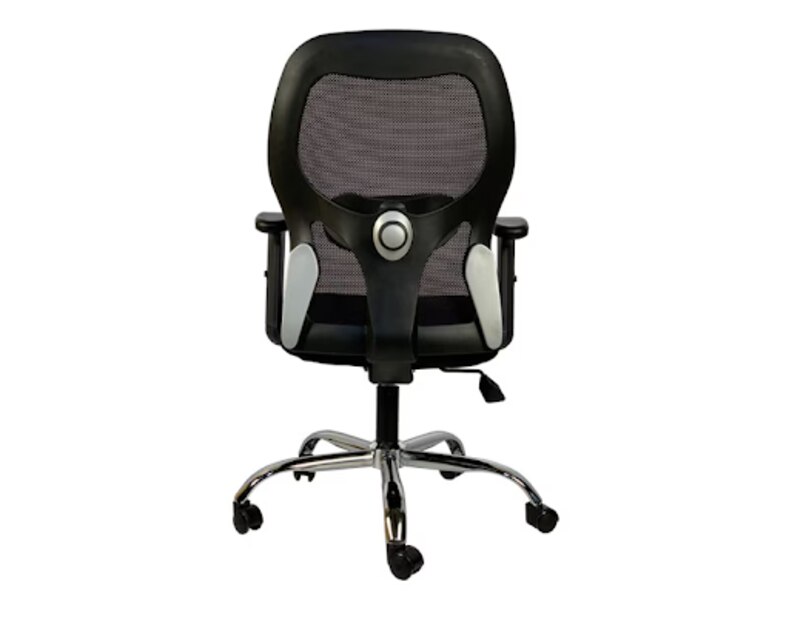
| Mesh backrest | Improves breathability and reduces heat, but poor tension or a rigid frame can press into your back. | Yarn construction, weave, edge attachment, tension, and tear or cyclic testing. |
| PU foam | Offers resilient cushioning but retains more heat than an open surface. Density and compression performance matter more than thickness. | Foam density, firmness, recovery, and replacement availability. |
| Moulded foam | Holds a shaped profile consistently and can distribute pressure better than a simple foam slab. | Seat contour, waterfall front, density, and compression-set results. |
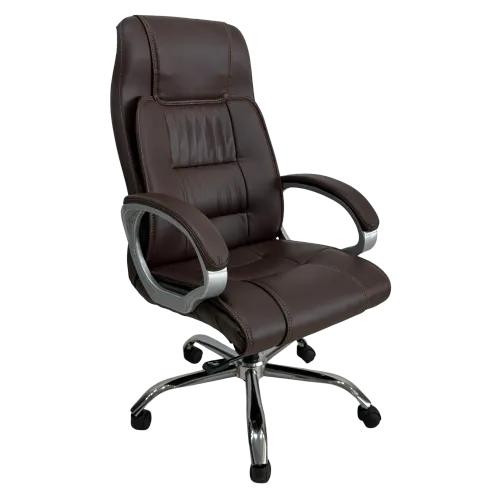
| Leather-look upholstery, leatherette, and synthetic leather | Wipe-clean surfaces resist spills, but heat, cracking, peeling, and hydrolysis depend on the construction. | Exact face material, backing, seams, and test method for PVC, PU, or microfiber upholstery. |
| Nylon base, iron base, and chrome base | Nylon reduces weight and resists corrosion; iron adds mass and stability; chrome offers a hard, cleanable finish but can scratch or corrode beneath damaged plating. | Base load rating, welds, coating thickness, and whether powder coating protects iron. |
| Caster materials | Hard wheels suit many carpeted floors; soft or dual-wheel casters reduce marking on hard floors. Wrong wheels increase rolling effort or floor damage. | Wheel diameter, braking, chair mass, floor sample, and replacement fit. |
A five-star base improves stability only when the casters match the floor and load. Ask for the complete chair specification, because a gas lift or attractive finish alone proves neither comfort nor service life.
Which Durability Evidence Should You Request From the Manufacturer?
“Commercial grade” and “heavy duty” prove nothing without a test method, tested load, result, and chair model. Request evidence tied to the exact configuration, because a stronger cylinder or metal base does not validate the seat, mechanism, or casters as a complete system.
| Claim | Credible evidence | Weak evidence |
|---|---|---|
| Commercial use | ANSI/BIFMA X5.1 or ANSI/BIFMA X5.11 test report, with tested load and pass result; EN 1335 is another named basis | “Heavy duty” with no standard or load |
| Structural life | Base load rating, caster size, and mechanism cycle rating stated for the supplied model | Generic claims about a reinforced base |
| Cushion life | Foam density and foam firmness IFD listed separately; density indicates material mass, while IFD indicates indentation resistance | “High-density foam” without figures |
| Mesh and upholstery | Mesh tension and tear resistance results; ASTM D4157 or ISO 12947 abrasion method, load, specimen, and endpoint | One abrasion-cycle number with no test method |
Ask for the report, not just a brochure line. Check that the ANSI/BIFMA X5.1 or X5.11 tested load matches your intended users and that the base load rating is not a rating for an untested component.
Treat ASTM D4157 and ISO 12947 abrasion results as separate measurements; their cycle counts are not interchangeable. A credible supplier names the machine, load, material, and failure endpoint, then identifies the exact chair model covered.
How Mechanisms and Adjustments Determine Whether a Chair Fits You
A push-back mechanism reclines the backrest when you lean into it; the seat pan stays largely fixed. A synchro mechanism links the backrest and seat pan, usually tilting the seat as the back reclines, so your hips and thighs keep a stable relationship.
Test the actual recline range, backrest force, tilt tension, tilt lock, forward tilt, and lock stability—not the number of positions alone.
| Mechanism | What moves | Check before choosing |
|---|---|---|
| Push-back mechanism | Backrest reclines; seat remains mostly stationary | Confirm the force required and whether the back locks securely |
| Synchro mechanism | Backrest and seat pan tilt together in a linked ratio | Check coordinated movement, recline range, and support at every position |
Fit starts with your body and desk, not the lever count. Ask for published minimum and maximum values, then check:
- Seat height adjustment: Set the seat height so both feet have stable foot placement and your knee angle is close to 90 degrees. Compare the available seat height with your desk height.
- Seat depth adjustment: Use your thigh length to leave roughly two to four fingers between the seat edge and the back of your knee.
- Armrest adjustment: Check height and width range; arms should rest without lifting your shoulders or colliding with the desk.
- Lumbar support and back height: Verify vertical position, depth, shape, and support through recline. Adjustable lumbar support adds fit potential, not automatic comfort.
- Cylinder and controls: A gas lift label does not prove safety. Request the tested chair model and ANSI/BIFMA or EN 1335 basis.
Which Chair Configuration Suits Your Room and Work Pattern?
A hot room and long shifts favour a breathable mesh back, while an executive office often suits an upholstered back for a softer, more formal appearance. Your floor type, cleaning demands, and user turnover matter as much as appearance.
| Option | What it means | When it applies |
|---|---|---|
| Mesh back | Taut fabric supports the back and releases heat | Choose for a hot room, long shifts, or a shared workstation; inspect tension and tear resistance |
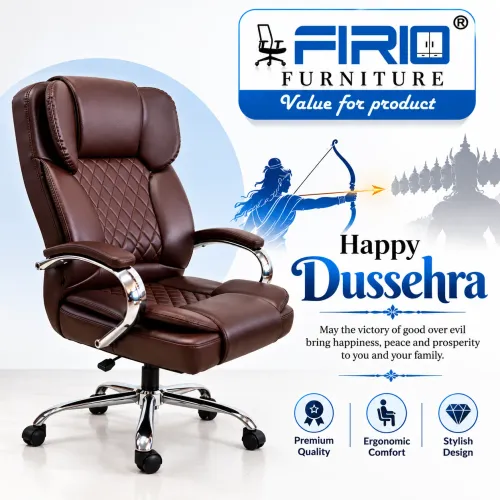
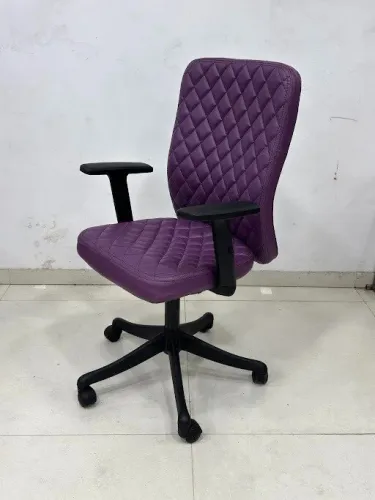
| Upholstered back | Foam and fabric or leather-look covering provide a padded feel | Choose for an executive office, quiet private room, or rooms where warmth matters more than ventilation |
| Fixed arms | Armrests stay at one height and width | Use where desks and users are uniform; they reduce adjustment points but can obstruct close desk positioning |
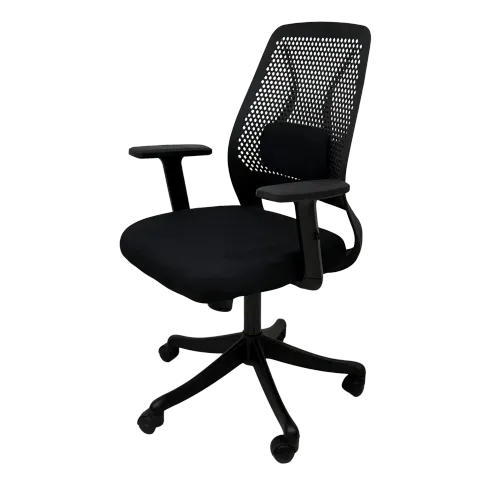
| Adjustable arms | Height, width, or pad position changes | Specify for hot-desking, a shared workstation, or users with different shoulder and desk heights |
| PU foam | Resilient cushioning with heat retention | Suitable for moderate use; compare density and firmness separately rather than accepting “high-density” alone |
| Moulded foam | Shaped foam with consistent contours and support | Better suited to long shifts and repeated use when the shape matches the user |
| Nylon base | Lightweight, corrosion-resistant five-star base | Works in ordinary offices with controlled loads and moderate movement |
| Metal base | Heavier base, commonly steel or aluminium | Prefer for an executive office or high-traffic environment where stability and impact resistance matter |
| Hard casters | Firmer wheels designed commonly for carpet | Select only after checking the floor type, chair mass, and wheel diameter |
| Soft casters | Softer wheels that reduce marking on hard floors | Use on timber, tile, or vinyl after testing braking behaviour |
| Dual-wheel casters | Two smaller wheels spread contact and improve manoeuvrability | Useful on hard floors, but verify they will not trap grit or damage delicate surfaces |
For carpet, hard casters are usually the safer match; for hard flooring, soft casters or dual-wheel casters usually protect the surface better. Test a sample in the actual room before ordering.
How to Test, Specify, and Maintain Chairs Before a Bulk Order
Inspect a production sample, not a showroom prototype. Perform a chair inspection for wobble, base flex, caster tracking, gas-lift creep, mechanism noise, uneven mesh tension, slow foam recovery, sharp edges, and loose armrests. Sit, recline, adjust, and roll it on the flooring used at your site.
1. Write the tested model and applicable standard into the specification: ANSI/BIFMA X5.1 for general-purpose chairs, ANSI/BIFMA X5.11 for large-occupant chairs, or EN 1335. State the user weight, daily-use rating, mechanism cycle result, base load rating, caster size, upholstery abrasion result, and adjustment ranges.
2. Specify the complete lift-and-frame system, not “Class 3” or “Class 4 gas lift” alone. Require the seat-height range, tested load, replacement gas lift, casters, arm pads, mechanism, and seat or back parts, plus a defined repair process.
3. Compare the warranty by component and exclusions. Record its term, labour coverage, upholstery and caster exclusions, response time, and replacement parts availability for the expected furniture life. Firio Furniture Industries ( R S Furniture) should provide these details with the sample quotation, alongside maintenance instructions.
4. Set a maintenance inspection schedule: check fasteners, casters, armrests, base, lift, and recline controls monthly in high-use areas. Record failures and remove a chair with structural movement from service.
5. Request material declarations showing recycled content and recyclability separately, and identify separation limits from foam, adhesives, metal inserts, and upholstery. Specify UL GREENGUARD Gold for emissions and TB117-2013 where flammability documentation is required; neither replaces mechanical testing.
Related items
office chair ₹11250 Office Chair Manufacturer Ergonomic Office Chair Supplier Executive Office Chair Maker Mesh Office Chair Manufacturer High-Back Office Chair... View product → |
Office Chair ₹6700 Product Code : M-1096 HIGHLIGHTS DETAILS : Iron Base with powder coating PU soft handle, Push Back mechanism, Premium Quality Caster, Premium power... View service → |
Frequently asked questions
How do office chair materials change daily use?
Mesh improves airflow, fabric offers a softer feel, leather-style upholstery simplifies wiping, and plastic handles spills but can feel warmer or harder.
What durability evidence should you request from an office chair manufacturer?
Ask for the chair’s load rating, test standard or report, warranty coverage, batch details, and availability of replacement casters, gas lifts, and armrests.
Which chair adjustments determine whether it fits you?
Check seat height, seat depth, back support, recline tension, armrest height, lumbar position, and whether your feet rest flat while working.
How should you choose a chair configuration for your office?
Match the chair to desk height, available floor space, user turnover, meeting or task work, cleaning needs, and the time people spend seated.
How should you test and maintain chairs before a bulk order?
Trial representative users, record adjustment ranges and pressure points, inspect moving parts, approve a sample, and set cleaning and inspection routines.
Related items
Executive Chair Executive Chair M-1091 ₹19200 Ergonomically designed for maximum comfort. Nylon star base for extra load carrying capacity. synchro mechanism. |
Mesh Back Chair Dynamic Chair ₹7400 Product Code : Dynamic Chair HIGHLIGHTS DETAILS : Nylon Base, Fix Handle, Synchro mechanism, Premium Quality Wheel, Premium power Hydrolic, PU Foam... |
Executive Chair Executive Chair Mesh Back M-1091 ₹19200 Ergonomically designed for maximum comfort. Heavy Duty Chrome base for extra load carrying capacity. Smart synchro mechanism. |
Chair Office Chair M-1047 ₹5500 Mesh Back Chair |