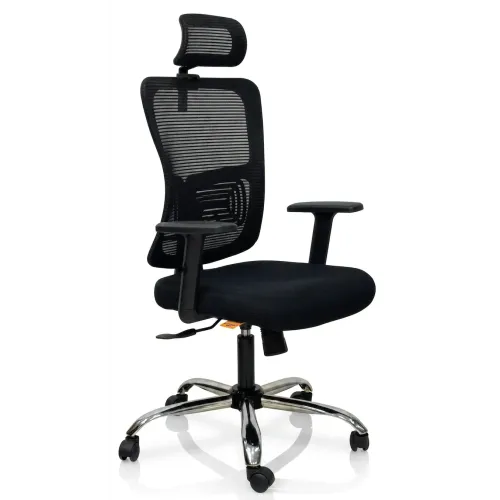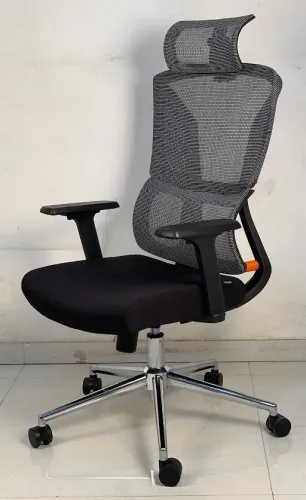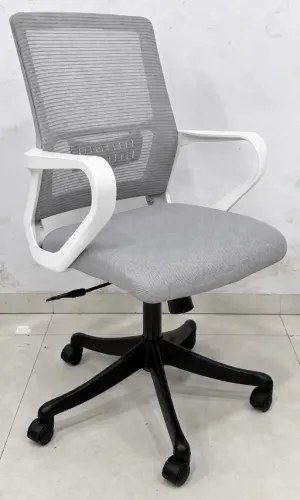
A chair that looks executive can still block a door, trap heat, prevent a desk from being used properly, or leave shorter users without stable foot support. By measuring the cabin, testing the chair’s adjustments and construction, and coordinating finishes and installation, you can create a room that feels comfortable, private, orderly, and professional.
Key takeaways
- Measure desk height, circulation paths, and chair clearance before choosing a model.
- Set seat height, depth, lumbar support, armrests, and recline for the user.
- Choose mechanisms that support focused work without compromising the cabin’s appearance.
- Ask the manufacturer to coordinate seating, desks, storage, and installation details.
Start with the Cabin Measurements, Not the Chair Catalogue
An executive chair fits the cabin only when its full adjustment range works with the desk, surrounding furniture, and circulation space.
Begin with a scaled plan or full-scale mock-up, because an ergonomic chair can still fail when its arms strike the worksurface, its five-star base catches the modesty panel, or its seat leaves a shorter user without stable foot support.
Record these measurements before selecting a model:
- Measure desk height, depth, and the underside clearance where the chair arms must pass.
- Mark chair clearance behind the desk with the backrest upright and reclined, using the widest boss chair dimensions.
- Place guest chairs and check spacing for sitting, standing, and passing without forcing visitors into the work zone.
- Draw the door swing, cabinet openings, and walkway routes on the plan.
- Trace the route from the entrance to the desk, including lift and stair access for delivery and installation.
- Check clear floor space and unobstructed approach routes against the accessibility rules that apply to the project.
Use these findings to review the executive cabin design and executive desk layout together. Specify seat-height and seat-depth ranges, lumbar adjustment, armrest height, and back-lock positions rather than judging a chair by its tall back or padding. Adjustable or removable arms help when desk heights or users differ.
A reclining mechanism with adjustable tension supports changing posture; upholstery height does not create speech privacy, which depends on the room’s doors, walls, ceiling, screens, and absorptive finishes.
Set the Chair for the Person Who Uses It
A comfortable executive chair starts with fit, not a tall back or thick padding. Use seat height adjustment to place both feet flat on the floor, keep the lower legs close to vertical, and leave the knees level with or slightly below the hips.
Adjust seat depth so the cushion supports the thighs without pressing behind the knees.
Chair ergonomics also depends on movement. Set lumbar support into the user’s lower-back curve, then adjust the backrest angle, tilt tension, and back-lock position for reading, screen work, calls, and meetings. Adjustable arms should let the shoulders relax while still clearing the desk; removable arms help when users have different builds or desk heights.
| Mesh | Breathable and supportive through the back | Choose it for warm rooms or users who dislike heat buildup |
|---|---|---|
| Leatherette | Wipe-clean, formal-looking, and resistant to routine spills | Choose it for a polished cabin where easy cleaning matters; check seam quality and heat retention |
| Fabric | Softer contact and less surface heat | Choose it for extended sitting when stain control is manageable |
Test the chair at the actual desk. A good mechanism becomes impractical if the arms hit the worksurface or the lowest seat setting leaves a shorter user’s feet unsupported. Ask for the recline operating range and user-weight range, and approve a full-scale sample before ordering several chairs.
Record the upholstery code and replacement options for casters, arm pads, gas lifts, mechanisms, and covers.
Choose Features for Work, Meetings, and Appearance
Compare boss chair features by adjustment range, clearance, and daily use—not by high-back size or padding alone. A proper task chair comparison asks whether the chair lets each user keep both feet flat, maintain approximately vertical lower legs, support the lower back, and approach the desk without the arms striking its edge.
| Option | What it means | When it applies |
|---|---|---|
| Basic tilt | The seat and back move together | Short work periods and simple meeting use |
| Synchro tilt mechanism | The back reclines farther than the seat, with coordinated movement | Computer work, reading, calls, and changing posture |
| Fixed arms | Arm height and width cannot change | One user and a precisely matched desk |
| Adjustable or removable arms | Arm position can suit different users and desk heights | Shared cabins or tight desk clearance |
| Mesh versus leatherette | Mesh improves airflow; leatherette gives a more formal, upholstered appearance | Choose mesh for heat management; choose leatherette when visual continuity matters |
Ask the manufacturer for back-lock positions, recline range, tilt-tension range, and the user-weight range for the mechanism. A chair that locks permanently upright can make reading and telephone work tiring, while loose tension can feel unstable.
Run a staffed trial with short and tall users before a large order. Test prolonged computer work, reclined reading, meeting posture, arm clearance, caster movement on the actual floor, and whether users understand the controls without instruction.
Approve the chair, desk, and visitor seating as one setting; a full-scale mock-up exposes clashes that catalogue dimensions miss. Record finish codes so the chair, table edge, storage fronts, and guest chairs retain a coordinated professional appearance.
Check Construction, Standards, and Daily Maintenance
Request evidence, not marketing language, before approving a chair for commercial use. “BIFMA certified” is incomplete unless the supplier names the exact ANSI/BIFMA X5.1 edition, tested configuration, test results, and exclusions for special executive models.
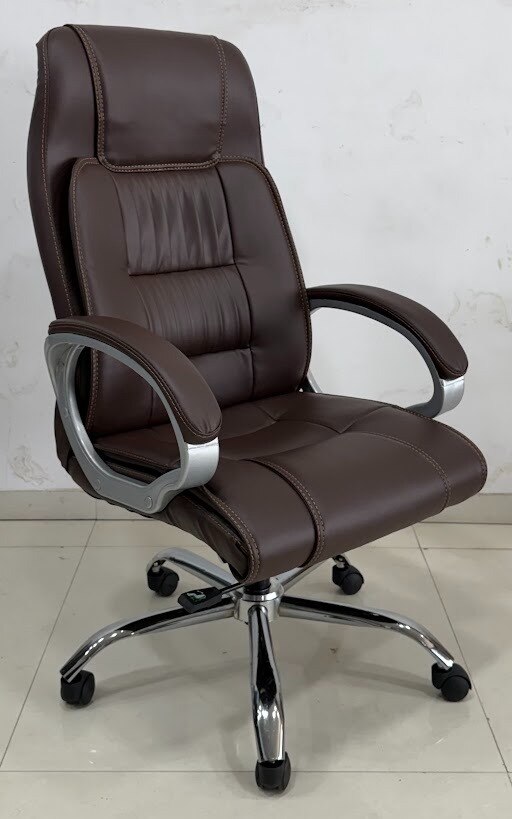
1. Inspect the five-star base, casters, gas lift, fasteners, arm supports, recline mechanism, and stitching for looseness or sharp edges. Ask for documented office chair durability testing and the chair weight rating, including the user and any applied load the mechanism is designed to support.
2. Confirm that the back-lock positions, recline range, and tilt tension suit computer work, reading, meetings, and telephone calls. A permanently upright lock restricts posture changes and becomes tiring during long sessions.
3. Request the complete upholstery specification: approved cleaning chemicals, abrasion rating, colorfastness, seam construction, repair method, and replacement availability. Include upholstery care instructions; harsh cleaners, body oils, heat, and repeated loading can peel coated materials or split seams.
4. For enclosed cabins, request low-emitting documentation for the finished chair, covering foam, adhesives, coatings, and upholstery. UL GREENGUARD Gold or the California Department of Public Health Standard Method may satisfy a project requirement, depending on its building standard and jurisdiction.
5. Conduct a staffed trial with short and tall users. Test prolonged computer work, reclined reading, meeting posture, armrest clearance, adjustment ease, and caster movement on the specified floor.
A tall chair does not provide speech privacy. Evaluate door seals, walls, ceiling, screens, and absorptive finishes as a room-level acoustic package.
Use the Manufacturer to Coordinate the Complete Cabin
A boss chair manufacturer can turn separate purchases into a usable cabin by coordinating the chair, desk, visitor seating, storage, and installation against one measured layout. The executive office furniture supplier should check door swing, approach space, desk clearance, visitor spacing, and the route needed to bring each item into the room.
Request a handover schedule covering:
- Recorded finish codes for the chair, table edge, storage fronts, and hardware, so replacements match rather than merely look similar.
- Chair installation instructions, adjustment settings, and the tested user-weight range for the reclining mechanism.
- Replacement parts availability for casters, arm pads, gas lifts, tilt mechanisms, and upholstery repair or replacement.
A reclining mechanism with back-lock positions and tension adjustment supports reading, screen work, meetings, and calls better than a chair locked permanently upright. The manufacturer must state the operating range; an attractive chair that cannot be adjusted for the user becomes a daily irritation.
Do not treat a tall chair as acoustic treatment. If confidential conversations occur, coordinate door seals, ceiling, wall construction, screens, and absorptive finishes at room level. Review clear floor space and unobstructed routes separately, because a large desk, fixed pedestal, or oversized chair can block approach and transfer space.
For commercial approval, ask Firio Furniture Industries ( R S Furniture) to identify the exact ANSI/BIFMA X5.1 edition, tested configuration, and exclusions for any special executive model.
Also request low-emitting documentation for the complete chair configuration, including foam, adhesives, coatings, and upholstery, through the project’s required route such as UL GREENGUARD Gold or California Department of Public Health Standard Method.
Frequently asked questions
What cabin measurements should you take before selecting an executive chair?
Measure desk height, available chair width and depth, clearance behind the chair, circulation paths, and space for guest seating.
How should you adjust an executive chair for its user?
Set seat height so feet rest flat, adjust seat depth for thigh support, position lumbar support, align armrests with the desk, and set recline tension for the user’s weight.
Which chair features matter in an executive cabin?
Choose features based on daily work and meetings, including adjustable lumbar support, a stable five-star base, smooth casters, recline control, and upholstery suited to the cabin’s appearance.
What should you check before buying a boss chair?
Check frame and base construction, adjustment range, upholstery quality, warranty terms, available maintenance parts, and any documented test or safety standards.